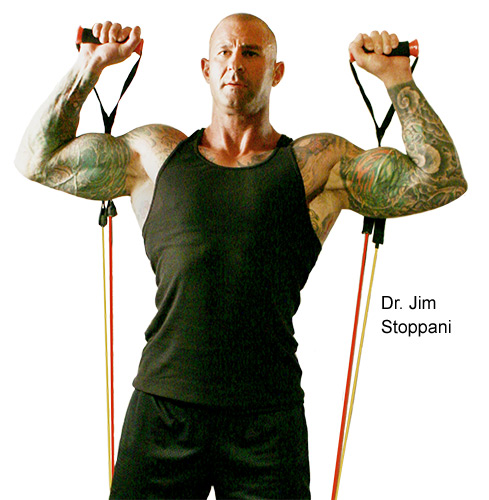

Short Answer: Can Resistance Bands Build Muscle?
Yes, resistance bands can build muscle. Studies comparing the same exercises done with elastic resistance and with free weights found similar muscle activity and similar peak load, and training programs using elastic bands increased muscle strength and size and decreased body fat in a similar way to free-weight programs. Bands also do several things free weights cannot: they resist in any direction, keep tension on the muscle through the whole rep, get harder as the muscle gets stronger, and stop you from cheating with momentum.
How Resistance Bands And Weights Are Alike
Elastic resistance exercise, such as training with elastic tubing, has been used for almost a century (6). It started as a fitness technique and later became a rehabilitation tool as well. Today it is used in fitness and rehabilitation facilities around the world.
Elastic resistance and free-weight resistance, such as barbells and dumbbells, share four properties:
- Both provide resistance.
- Both allow a free range of motion.
- Both allow you to move at any speed.
- Both allow progressive resistance.
All four are critical to the benefits of an effective resistance training program.
Because elastic tubing looks light and flimsy, many people assume free weights must be better. Studies show otherwise. Muscle activity and peak load during elastic resistance exercise are similar to free-weight exercise (3, 7). When the same exercise is performed with an elastic device or with free weights, a similar number of muscle fibers is activated, and those fibers produce a similar amount of force.
Studies on elastic resistance training have also shown that programs using elastic tubing, elastic bands and similar devices increase muscle strength and muscle size and decrease body fat in a similar manner to free-weight programs (1, 2, 4, 7, 9).
Bands Resist In Every Direction, Not Just Against Gravity
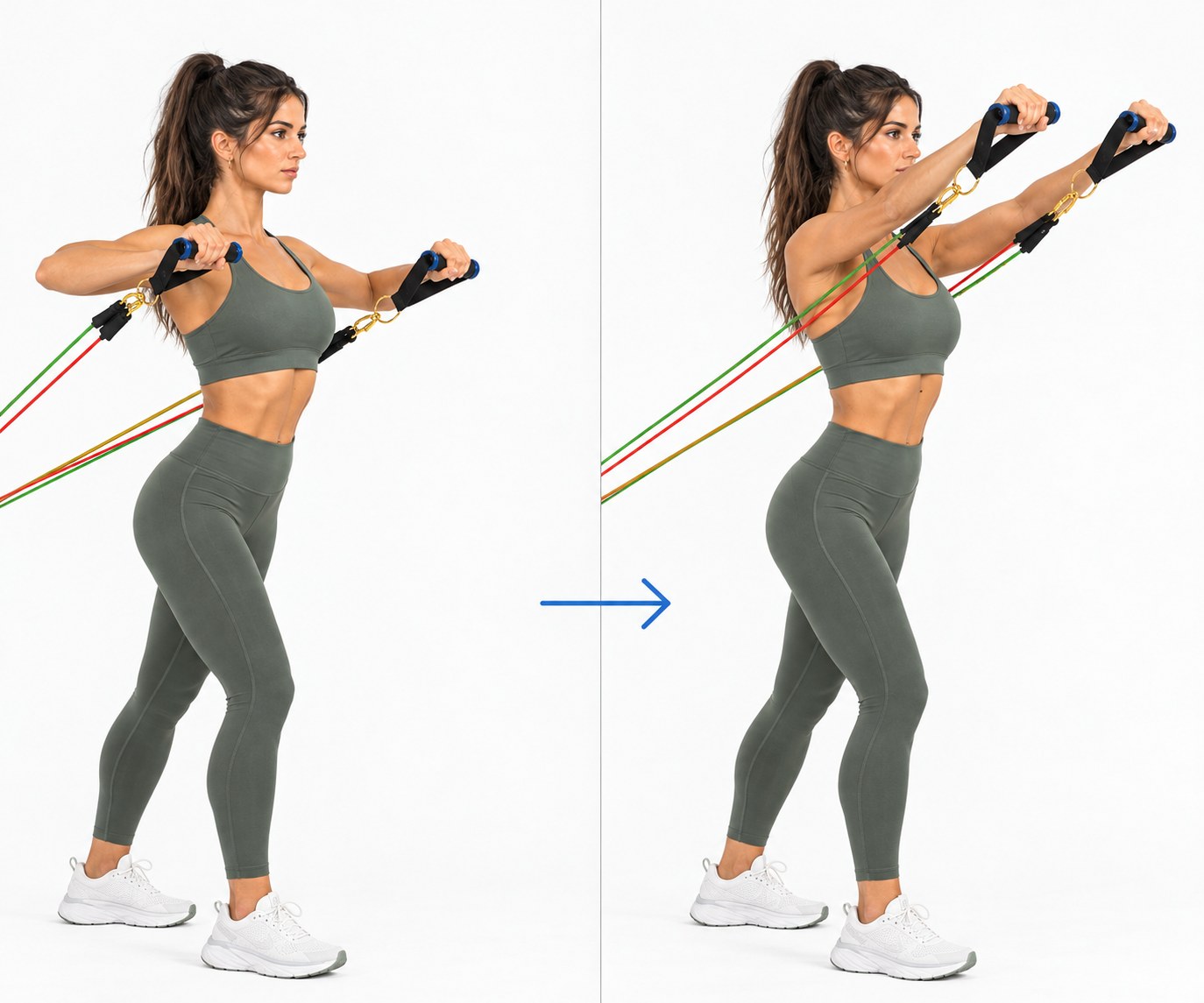
Beyond those similarities, elastic resistance offers several benefits that free weights do not.
One of the most important is that elastic resistance does not rely on gravity. Free weights can only resist in a vertical plane, the direction of gravity. Move a dumbbell from the left side of your body to the right in a horizontal plane and there is no resistance to that movement.
With elastic tubing, you have resistance in a horizontal plane too. You can twist your body from side to side, throw side kicks and punches, and mimic a baseball swing or a basketball pass. Training in a horizontal plane prepares you for daily tasks, such as turning while carrying a heavy box, with less risk of injury. It also prepares athletes for movements like swinging a bat, and helps prevent sports injuries.
A study published in a 1998 issue of the American Journal of Sports Medicine reported that collegiate tennis players who trained with elastic bands increased their shoulder strength and the speed of their serve (12). Another study, from Louisiana State University in New Orleans, found that an elastic band program strengthened the rotator cuff muscles of collegiate baseball pitchers better than a program using free-weight dumbbells (9).
Change Which Muscles Do The Work
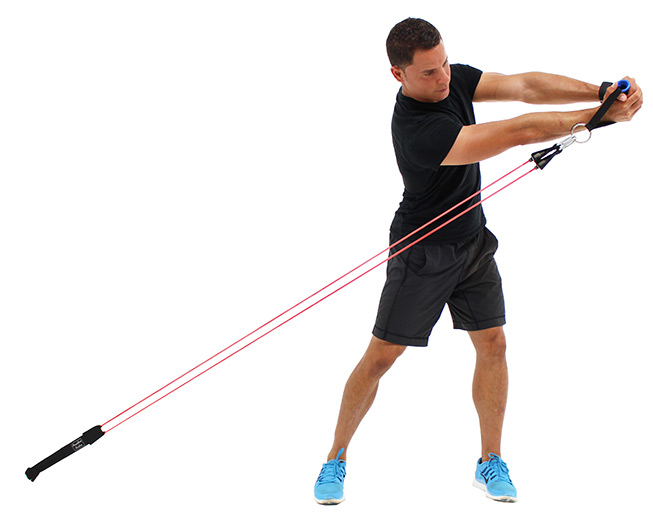
Because elastic resistance does not rely on gravity, you can change which muscles an exercise emphasizes by changing the direction the band pulls. Research from Brigham Young University found that changing the direction of pull of elastic tubing shifted the emphasis between the quadriceps and hamstrings during squatting and stepping exercises (10).
That matters if you want to target specific muscles, for looks or for sport. It also matters after an injury, because shifting force toward certain muscles can help protect the joints around them. For example, greater hamstring emphasis during squatting or stepping exercises helps protect structures around the knee (10). This is hard to do with free weights, because their resistance always points straight down.
Constant Tension Through The Whole Rep
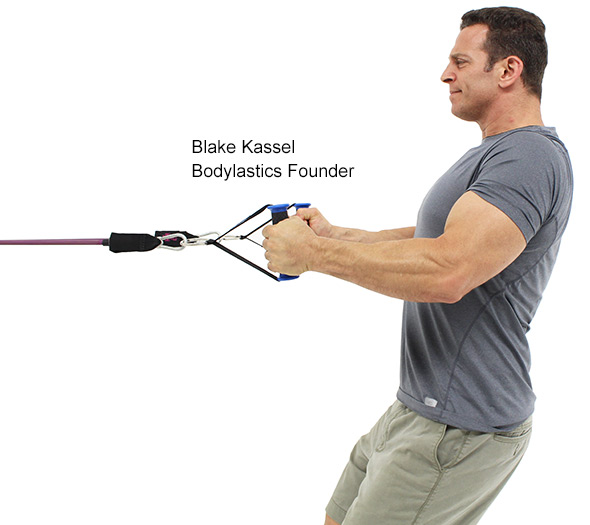
Elastic resistance also keeps continuous tension on the muscle. When you lift a free weight in any direction other than straight up and down, the tension on the muscle can disappear at points in the range of motion.
Take the biceps curl. As you curl a dumbbell toward your shoulder, at the very top of the movement the dumbbell is literally falling toward your shoulder. The biceps is no longer lifting it against gravity, so the tension is gone. Curl with an elastic band and the tension stays through the entire range of motion, because the band resists by its own properties.
Bands Get Harder As Your Muscle Gets Stronger
Elastic resistance offers something free weights cannot: linear variable resistance. As the band stretches, its resistance increases (11). In a biceps curl, the resistance of the tubing rises as your hand comes up toward your shoulder. As the resistance increases, so does the number of muscle fibers working. The more fibers you use, the greater the gains in strength a program can produce.
This also matches what is known as the strength curve of most muscles, the way a muscle's strength changes across a range of motion. Because of their anatomy, most muscles get stronger through the range of motion up to a certain point. The biceps is weakest at the start of a curl and strongest at about the halfway point. With a dumbbell, the weight you can use is limited by how strong your biceps is at its weakest point, so the muscle is under-loaded where it is strongest. With elastic tubing, the resistance rises as the range of motion increases, so the muscle gets more resistance at its strongest point, and a better stimulus for strength.
Many people who train with bands say they feel a stronger burn and more fatigue than with free weights. That is the variable resistance at work, and research backs it up. A study at Truman State University in Kirksville, Missouri found that athletes who added elastic resistance bench press training increased their bench press strength and power significantly more than athletes who used free weights only (5). A study at the University of Wisconsin-La Crosse, published in a 2006 issue of the Journal of Strength and Conditioning Research, reported that athletes who added elastic band training to free-weight training developed significantly more leg power than with free weights alone (13).
Bands Stop You Cheating With Momentum
A critical benefit of elastic resistance is that it stops you from cheating (6). Cheating, common among beginners with free weights, means using momentum to get the weight moving. Once a weight has momentum, the muscle no longer has to work fully to move it through the rest of the rep.
Elastic resistance does not allow that. The resistance comes from stretching the band, not from the mass of the equipment, so the only way to keep the movement going is to recruit more muscle fibers and keep stretching the band.
Cheaper, Lighter And Easier To Store
Because elastic resistance does not rely on gravity, the equipment can be inexpensive, lightweight and easy to store and carry, and still provide strong resistance (11). Free weights must be heavy and cumbersome to provide strong resistance, and they tend to be expensive, because they are usually priced by the pound.
Resistance Bands Vs Free Weights: Benefits Compared
| Benefit | Resistance Bands | Free Weights |
|---|---|---|
| Provides resistance | ✓ | ✓ |
| Provides progressive resistance | ✓ | ✓ |
| Allows free movement | ✓ | ✓ |
| Allows variable speed of movement | ✓ | ✓ |
| Increases muscle strength | ✓ | ✓ |
| Increases muscle size | ✓ | ✓ |
| Decreases body fat | ✓ | ✓ |
| Provides resistance in multiple directions | ✓ | – |
| Provides variable resistance | ✓ | – |
| Provides constant tension | ✓ | – |
| Prevents cheating | ✓ | – |
| Inexpensive | ✓ | – |
| Easy to store | ✓ | – |
| Easy to transport | ✓ | – |
The Bottom Line
The research on elastic resistance suggests that it not only offers benefits similar to free weights, it has several benefits that outweigh (pun intended) those of free weights.
A program using elastic tubing can deliver what a free-weight program delivers: more strength, more muscle tone and size, and less body fat. It can also deliver what free weights cannot: more functional strength, better injury prevention, the ability to change muscle emphasis, greater power development and easier use.
References
- Aniansson, A. P., et al. Effect of a training programme for pensioners on condition and muscular strength. Archives of Gerontology and Geriatrics 3:229-241, 1984.
- Boyer, B. T. A comparison of the effects of three strength training programs on women. Journal of Applied Sport Science Research 4(3):88-94, 1990.
- Ebben, W. P. and Jensen, R. L. Electromyographic and kinetic analysis of traditional, chain, and elastic band squats. The Journal of Strength and Conditioning Research 16(4):547-550, 2002.
- Fornataro, S., et al. Investigation to determine differences in strength gains using Thera-Band at fast and slow training speeds. Physical Therapy 74(5):S53, 1994.
- Heinecke, M., et al. Comparison of Strength Gains in Variable Resistance Bench Press and Isotonic Bench Press. The Journal of Strength and Conditioning Research 18(4):e361, 2004.
- Hughes, C. and Page, P. Scientific Basis of Elastic Resistance. In The Scientific and Clinical Application of Elastic Resistance (Page, P. and Ellenbecker, T. S., eds). Human Kinetics, Champaign, IL: 3-14, 2003.
- Matheson, J. W., et al. Electromyographic activity and applied load during seated quadriceps exercises. Medicine & Science in Sports & Exercise 33(10):1713-1725, 2001.
- Mikesky, A. E., et al. Efficacy of a home-based training program for older adults using elastic tubing. European Journal of Applied Physiology and Occupational Physiology 69(4):316-320, 1994.
- Page, P. A. Posterior Rotator Cuff Strengthening Using Theraband in a Functional Diagonal Pattern in Collegiate Baseball Pitchers. Journal of Athletic Training 28(4):346-354, 1993.
- Schulthies, S. S., et al. An Electromyographic Investigation of 4 Elastic-Tubing Closed Kinetic Chain Exercises After Anterior Cruciate Ligament Reconstruction. Journal of Athletic Training 33(4):328-335, 1998.
- Stoppani, J. Encyclopedia of Muscle & Strength. Human Kinetics, Champaign, IL, 2005.
- Treiber, F. A., et al. Effects of Theraband and lightweight dumbbell training on shoulder rotation torque and serve performance in college tennis players. American Journal of Sports Medicine 26(4):510-515, 1998.
- Wallace, B. J., et al. Effects of elastic bands on force and power characteristics during the back squat exercise. The Journal of Strength and Conditioning Research 20(2):268-272, 2006.